
Emergency Chimney Sweep Near Me: What Rancho Park Homeowners Should Do First
If you’re searching “emergency chimney sweep near me” in Rancho Park, the first thing to know is that a true chimney emergency falls into two buckets: one where you call 911 before anyone else, and one where you call us. An active chimney fire, a carbon monoxide alarm with symptoms, or visible smoke pushing through mortar joints are fire-department situations. Sudden heavy smoke inside the house, water pouring through the firebox, or a strong backdraft smell are cases where you shut the damper, open a window, and call (877) 326-6276. We’ll walk you through exactly what to do while you wait, because the first 15 minutes matter more than most people realize.
A chimney fire sounds like a freight train inside the wall. It burns at over 2,000°F and can crack terra cotta flue liners in under a minute. By the time a sweep arrives in Rancho Park, the question isn’t whether the flue is damaged. It’s how badly, and what you did in those first minutes determines a lot of that answer.
Three Chimney Emergencies That Require 911 Before You Call a Sweep
Not every chimney scare is a fire. But three specific scenarios in Rancho Park homes demand the fire department first, and the sweep second. Here’s how to tell the difference.
- Active chimney fire. You’ll hear it before you see it. A low rumble or roar inside the flue, often described as a train or jet engine. Flames or dense smoke may shoot from the chimney top. Call 911, evacuate, and do not attempt to use water.
- Carbon monoxide alarm with symptoms. Headache, nausea, dizziness, or confusion alongside a CO alarm is a medical event. Leave the house immediately. Call 911 from outside. Do not open windows and wait it out.
- Visible exterior smoke through mortar joints. If smoke is escaping through the brick itself rather than the chimney cap, heat has found a path through a cracked flue and into your home’s structure. That’s structural fire risk, and it needs the fire department before any inspection happens.
We’ve responded to post-fire inspections in Rancho Park where homeowners underreacted to a chimney fire they thought had burned itself out. The creosote ignited, burned hot for ten or twenty minutes, and then starved out. No flames visible afterward. But the terra cotta liner had shattered in three places, and the next fire would have pushed into the attic. That’s the cost of guessing wrong.
What to Do During a Chimney Fire in the First 15 Minutes
The fire department’s average response time in Los Angeles is around five to seven minutes, but it can stretch longer depending on call volume. What you do before they arrive either contains the situation or feeds it. Here’s the order of operations, drawn from what we tell Rancho Park homeowners after every emergency call we follow up on.
- Close the damper if you can reach it safely. Cutting off oxygen slows the fire. Do not reach into a hot firebox or struggle with a stuck damper handle. If it’s already too hot to touch, move on.
- Close fireplace doors or glass screens. This creates a barrier between the fire and your living space. If you have an open hearth with no doors, keep the area clear and evacuate.
- Do not use water. Water on a chimney fire creates steam and can crack masonry or send burning material out of the firebox. It does not extinguish a fire burning inside the flue. Let the fire department handle it.
- Evacuate everyone, including pets. Once you’ve closed the damper and fireplace doors, get out. Do not go back for belongings.
- Call 911 from outside. Tell the dispatcher it’s a chimney fire, not a fireplace fire. That distinction changes the response protocol.
One more thing we tell homeowners after these events: a chimney fire that went out on its own is not a pass. It’s a data point. The creosote burned, which means the flue was already overloaded, which means the system was already failing before the fire started.
Self-Extinguished Chimney Fire vs. Compromised Liner: How to Tell, and Why It Matters
A chimney fire that burns itself out creates a dangerous illusion. No flames, no smoke, no obvious problem. But inside the flue, the damage can be catastrophic. The difference between a fire that just scorched the creosote and one that cracked the liner isn’t visible from the ground or the fireplace.
Under NFPA 211, the standard for chimney inspection, any chimney fire requires a Level 2 inspection before the fireplace is used again. That inspection includes a video scan of the entire flue interior. Here’s what the scan reveals and what it means for your home.
- Lightning-fast heat rise cracks terra cotta. Clay liners handle normal fireplace temperatures around 1,000°F. A chimney fire pushes 2,000°F or higher. The thermal shock can split the liner in a matter of seconds.
- Cracked liners create pathways into your walls. Once the flue liner is compromised, heat and gases can move through the masonry into wall cavities, attics, and floor systems. The next fire you light could start a fire you never see.
- Mortar joints fail under the same stress. Even if the liner survives, the joints between sections can open up, allowing carbon monoxide to seep into living space during normal use.
- A Level 2 inspection documents all of it. The video footage shows exactly what failed and where. That’s the document your insurance adjuster needs, and it’s the reason we recommend it before you use the fireplace even once more.
We work with Chimney Repair in Rancho Park cases weekly where a liner cracked years ago and the homeowner never knew. The fire isn’t always dramatic. Sometimes it’s a slow creosote smolder that takes 15 minutes and sounds like a rainstick. Same result: compromised flue, false sense of safety.
If the liner is damaged, heat doesn’t fix itself with time. The repair path is either a resurfacing system like HeatShield, which uses a ceramic compound to seal cracks and restore the flue’s integrity, or a flexible liner system like DuraFlex when the damage is structural. Both are specification-grade materials we stock specifically because Rancho Park homes in older neighborhoods have flues from the 1940s through the 1970s, and the original terra cotta is almost always at the end of its service life.
Carbon Monoxide Events: What the Post-Event Inspection Must Include
When a CO alarm goes off and a Rancho Park homeowner calls us, the assumption is usually a faulty furnace or water heater. In our experience, it’s the chimney more often than not. Flue obstruction and failed liner seals are the two most common culprits we find, and both are chimney problems, not appliance problems.
Here’s how a CO event traced to the chimney actually works. Your furnace, water heater, or gas fireplace vents through the flue. If the flue is blocked – a bird nest, a dead raccoon, twenty years of creosote – the exhaust can’t exit. It backs up into the house. If the liner seal has failed, the gases leak through the joints and into wall cavities, where they find their way into living space. The appliance is working. The chimney isn’t.
That’s why any post-CO inspection in Rancho Park should include these four items:
- Full camera scan of the flue from top to bottom. Not a flashlight check from the roof. A video scan that documents every inch.
- Visual inspection of the flue cap and termination. Damaged caps let rain, debris, and animals in. A missing cap is a standing invitation for a raccoon.
- Combustion appliance zone check. Making sure the water heater and furnace vents are properly connected and sealed to the chimney, not just shoved into a wall opening.
- Creosote level and type assessment. Different creosote types burn at different temperatures. Stage three creosote is a thick, tar-like glaze that ignites easily and burns hot. You can’t sweep it out with a standard brush.
We keep Copperfield and Famco components on hand for repairs because they’re engineered for specific venting applications, not improvised from whatever the local hardware store stocks. When the fix involves a termination cap, a rain guard, or a connector seal, using the right part matters more than homeowners expect.
What to Ask an Emergency Sweep to Document for Your Insurance Claim
If you’ve had a chimney fire or CO event, your insurance adjuster will want documentation that pinpoints the cause, the damage, and the repair plan. Most adjusters know roofs and water heaters. They don’t know chimneys. The more specific your sweep’s documentation, the smoother the claim.
Ask for these items before the sweep leaves your property:
- Dated video footage of the internal flue scan. The footage should show the crack, the blockage, or the failed material, not just a written summary.
- Written description of the damage mechanism. “Thermal shock fracture of terra cotta liner at 12 feet above firebox, consistent with chimney fire temperatures” is what an adjuster needs. “Chimney is broken” is not.
- Creosote stage and location documentation. This supports the argument that the fire was fueled by creosote accumulation, which is a maintenance issue, and that the subsequent liner damage was caused by the fire event.
- Repair specification with product names. If the liner needs replacement, the document should specify DuraFlex or an equivalent professional liner system. Generic “liner replacement” language triggers adjuster skepticism.
- Recommendation for NFPA 211 Level 2 compliance. This is the industry standard, and it tells the adjuster the inspection was conducted by someone who knows the code.
We’ve walked Rancho Park homeowners through enough of these claims to know that a one-page form letter from a generalist doesn’t hold up. Specific documentation does. It also protects you from an adjuster offering to cover a patch job when the flue needs full resurfacing or replacement.
Why a Proper Chimney Sweep Is Not the Same as a Fireplace Cleaning
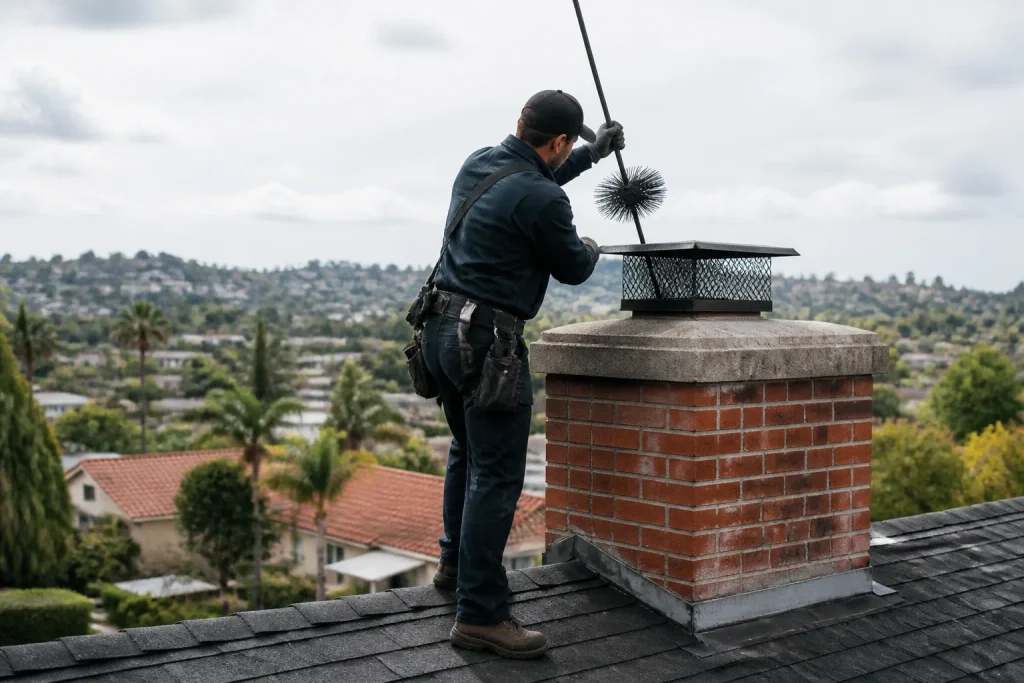
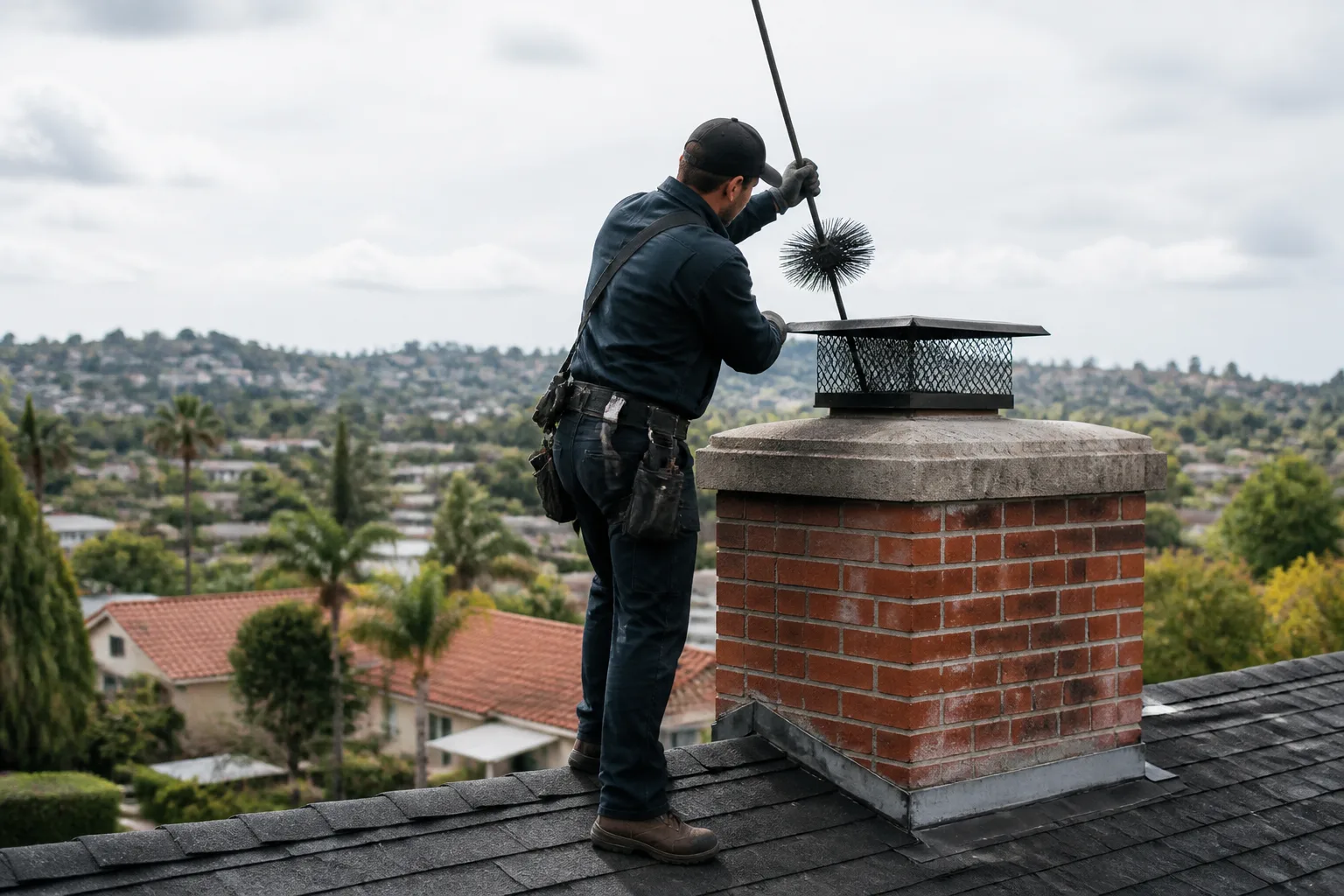
The phrase “chimney sweep” gets thrown around loosely, but the difference between a professional sweep and a basic fireplace cleaning shows up in the equipment, the technique, and what gets checked. A fireplace cleaning removes visible soot from the firebox. A proper chimney sweep clears the entire flue system – the part you can’t see, where the fire hazard actually lives.
In Rancho Park, we routinely work on fireplaces that haven’t been properly swept in years, sometimes decades. Homeowners show us fireplaces that look clean because someone brushed the firebox and vacuumed the ash. But the flue above is caked with stage three creosote, the damper is rusted half-shut, and the smoke shelf is packed with years of debris. That’s the difference between a cosmetic job and a safety service.
Our approach is built around three service lines, because the chimney and the vent system are one safety category: Chimney Sweep in Rancho Park, Chimney Repair in Rancho Park, and Dryer Vent Cleaning in Rancho Park. The reason we include dryer vents isn’t to pad a service menu. It’s that both systems move combustion exhaust and heated air out of your home, and both fail in similar, preventable ways. A clogged dryer vent and a blocked chimney flue are the same problem in different rooms.
We also don’t carry generic parts. When a cap needs replacing, we install Copperfield or Famco. When a liner needs work, we use HeatShield for resurfacing or DuraFlex for full replacement. These are the products professional chimney contractors use nationwide, and they’re not sitting on the shelf at a big-box store. That’s the point. The right liner for the job is the difference between a repair that lasts 20 years and one you’re redoing in 5.
When to Call a Pro
You should call a professional any time the problem is in the flue, not the firebox. If you can see the problem – a soot stain, a damaged cap, a visible blockage – a sweep can confirm and fix it. If the problem is invisible – a CO alarm, a weird smell, backdraft smoke – that’s exactly when the camera scan earns its cost. Homeowners who try to diagnose flue problems without a scan end up guessing, and guessing wrong with a combustion system is how houses burn down.
That said, not everything is an emergency. If your chimney has been fine and you’re wondering whether to book a sweep before burning season, the answer is yes, and it doesn’t need to be a panic. A clean flue isn’t a luxury. It’s how your system is supposed to work. Book the sweep, get the video documentation, and burn with confidence. If you’ve burned more than a cord of wood since your last sweep, or if you can’t remember when the last sweep happened, it’s time.
The Bottom Line
Here’s what to remember from all of this. An active chimney fire, a CO alarm with symptoms, or visible smoke through mortar joints means 911 first, sweep second. What you do in the first 15 minutes – close the damper, close the doors, don’t use water, evacuate – determines how bad the damage gets. A chimney fire that seems to go out on its own still requires a Level 2 inspection before you burn again, because the liner is almost certainly compromised. And if you’re dealing with insurance, demand specific documentation with video footage, product names, and damage mechanism descriptions.
If you’re in Rancho Park and need help, whether it’s a true emergency follow-up or a pre-season sweep, call us at (877) 326-6276. We’ll tell you what’s wrong, show you the footage, and give you an honest answer about what needs to happen next – even if that answer is “nothing, you’re fine.” Chimney Sweep Rancho Park home has been serving the neighborhood since 2011, and we’d rather you call before the freight train sound starts.
Frequently Asked Questions
An emergency chimney sweep in Rancho Park typically costs between $250 and $450, depending on the flue condition and whether a Level 2 camera inspection is needed after the event. Post-fire inspections are priced separately from standard sweeps because they require full video documentation. Call (877) 326-6276 for an exact quote – estimates are free.
Chimney fire damage is usually covered by homeowners insurance, but the claim process depends heavily on documentation. An adjuster needs video footage of the internal flue damage, a written description of what failed and why, and a repair specification that names the materials being used. Without that specificity, claims get denied or underpaid.
Not until a Level 2 inspection is completed and any damage is repaired. Under NFPA 211, the standard for chimney inspection, any chimney fire triggers the requirement for a Level 2 inspection before the next use. That inspection includes a full video scan of the flue, and if the liner is cracked, the fireplace stays out of service until repairs are done. There is no safe “wait and see” period.
Yes, depending on the severity and location of the crack. Hairline cracks and minor damage can often be resurfaced with HeatShield, a ceramic sealant system applied from inside the flue. More extensive structural damage requires a full liner replacement, typically with a DuraFlex flexible stainless steel system. The camera scan tells you which path applies to your chimney.
Written by the team at Chimney Sweep Rancho Park, serving Rancho Park since 2011.
Need Chimney Cleaning Help?
Call Chimney Sweep Rancho Park - licensed & insured, with free written estimates in Rancho Park.
(877) 326-6276