
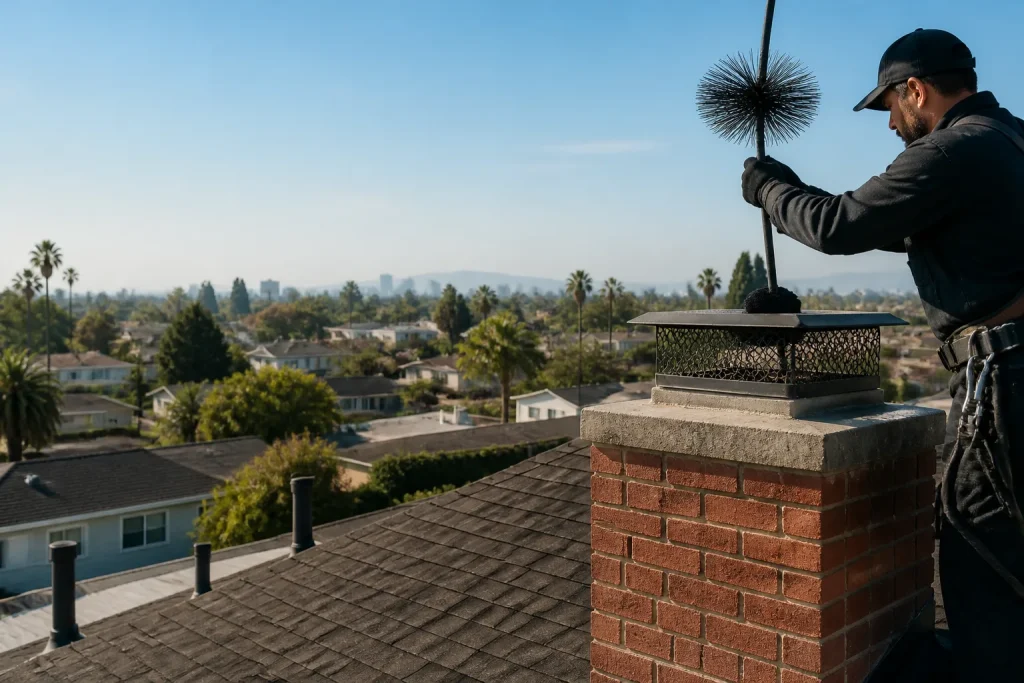
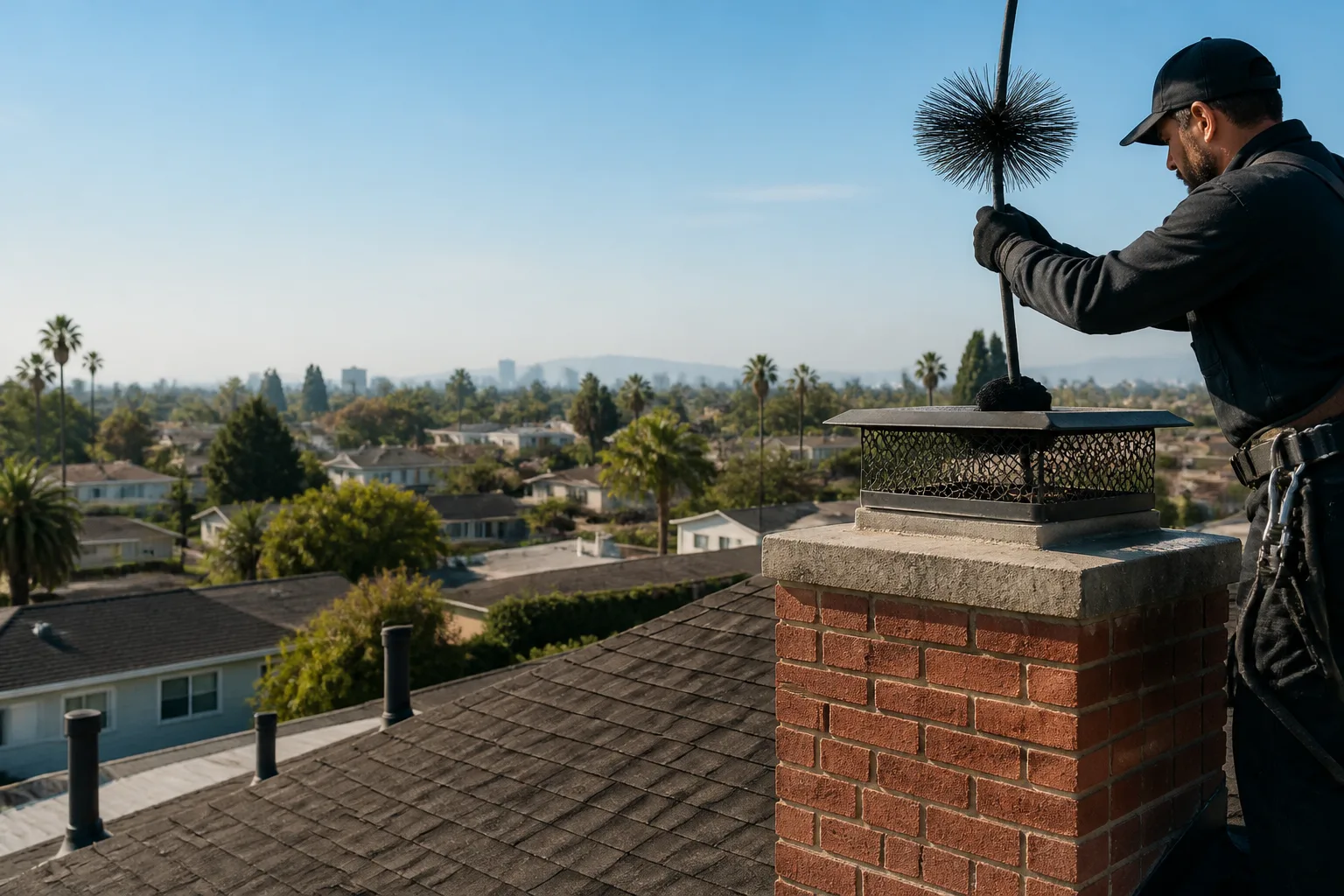
Chimney Sweep Cost Guide: What Rancho Park Homeowners Pay in 2026
A professional chimney sweep in Rancho Park runs $189 to $340 for a standard cleaning with a Level 1 inspection, while full liner replacements typically land between $1,800 and $3,800 depending on material and flue height. The spread exists because two companies can use the same words “chimney sweep” to describe completely different scopes of work. If you’d rather skip the research and get a straight number for your specific fireplace, call (877) 326-6276 for a free estimate.
Most Rancho Park homeowners we talk to have no idea what they should actually be paying. They’ve seen the $99 coupon in the mailer, they’ve heard a neighbor mention a $2,000 repair, and they don’t know which number is real. Both are. They’re just for different things. Here’s how to tell them apart.
Key Takeaways
- A legitimate sweep with Level 1 inspection costs $189 – $340 in Rancho Park; anything under $150 is usually an inspection-only lead generator, not a full service.
- Liner work with DuraFlex or Copperfield materials runs higher than generic flex because the material itself is built to different tolerances, and it’s installed to code, not shortcut.
- Deferring a $350 crown repair now can turn into a $2,200 liner replacement within two or three rainy seasons in Rancho Park.
- Any estimate that uses “safety hazard” language without citing the specific NFPA code section it’s based on deserves a second opinion.
What a Standard Chimney Sweep Actually Costs in Rancho Park
Here’s the honest breakdown for 2026. A standard sweep of a single-flue masonry fireplace with a Level 1 visual inspection runs $189 to $280 in Rancho Park. That includes the brush work from the firebox up through the flue, the drop cloth and vacuum containment, and a visual check of the firebox, damper, flue liner, and chimney crown from the roof or the firebox opening. Add a second flue, a wood stove with a connector pipe that needs disassembly, or a chimney that hasn’t been cleaned in more than three years, and you’re looking at $280 to $340. Heavy creosote buildup (the shiny, tar-like third-stage stuff) adds labor because standard brushes don’t cut it cleanly, and that’s where the higher end of the range comes from.
What’s not included is worth knowing before you book. Chase covers, rain caps, damper replacements, crown sealing, and flue liner repairs are all separate line items. The $99 specials you see in Rancho Park coupon mailers are inspection-only. The inspection is real enough, but it’s priced to get the technician access to the chimney, not to deliver the condition report. We’ve followed behind enough of those to know: the majority of homeowners who book a sub-$130 “sweep and inspection” end up with a recommendation list that has little to do with what the chimney actually needs right now. A real sweep includes a real cleaning, and the inspection is part of it, not the hook.
What a Level 1 Inspection Covers vs. What’s Always Extra
This is the distinction that saves Rancho Park homeowners the most money, and almost nobody explains it in writing. A Level 1 inspection is a visual check of the readily accessible parts of the chimney: the firebox, damper, flue (what’s visible from above and below), exterior brick, mortar joints, and crown. It’s done with a flashlight and basic hand tools, and it’s included in a properly priced sweep. It does not include a camera scan of the flue interior.
Here’s what’s always a separate line item:
- Level 2 camera inspection: $150 – $300 in Rancho Park. Required for real estate transactions, after a chimney fire, or when a liner condition issue is suspected. The camera goes up the full flue and documents every joint, crack, and offset.
- Chase cover replacement: $250 – $650 depending on material. Galvanized is cheaper than stainless. Copper chase covers run higher but last decades in Rancho Park’s coastal air.
- Damper replacement or repair: $180 – $400 for a throat damper, $450 – $900 for a top-sealing damper that actually stops the conditioned air from escaping when the fireplace isn’t in use.
- Crown sealing or rebuilding: $180 – $350 for a proper seal with a flexible crown-coat product; $900 – $1,800 for a full crown rebuild when the concrete has spalled past the point of patching.
- Flue liner repair or replacement: $1,800 – $3,800 for a full liner install, which we’ll get to below because this is the line item that gets people overcharged the most.
When you get an estimate that bundles “sweep + liner inspection + safety check” for $400 without breaking out what each part costs, that’s your signal to ask questions. A legitimate estimate lists line items individually. A vague one is built to make the number feel justified without having to defend any individual line.
Liner Replacement Costs: Why DuraFlex and Copperfield Jobs Run Higher
A full liner replacement in a Rancho Park chimney runs $1,800 to $3,800, with the material choice driving most of that spread. Generic flex liner kits you can buy online start around $300 to $600 for the material alone, and they fail at the seams and joints because the metal is thinner and the connectors aren’t engineered for the thermal cycling a working chimney goes through every burn season.
DuraFlex, which is the liner stock we work with, is built by DuraVent to a different specification. The alloy wall is thicker, the seam construction is welded rather than snap-locked, and the insulation wrap is rated for the continuous operating temperatures of a wood-burning system, not just the intermittent exposure of a gas appliance. A DuraFlex liner install also includes a proper tee at the base, a rain cap at the top, and a connection to the appliance collar that’s sized to the specific flue diameter, not adapted with a reducer ring and some foil tape. Copperfield components are the same principle: stainless steel components machined for the termination and connection points, not generic sheet metal bent to fit.
The labor difference matters as much as the material. A proper liner install takes half a day to a full day for a two-person crew. It involves setting up rooftop access, dropping the liner through the flue, centering it, insulating it, and reconnecting the appliance. A quick liner swap with no insulation wrap and a generic cap can be done in half that time, and it fails in half the years. When you see a $1,200 liner quote next to a $3,200 quote, the difference is rarely the labor markup. It’s the material, the insulation, the connection hardware, and the attention to whether the liner is actually sized for the appliance it’s serving.
We pulled a liner out of a chimney off Cheviot Hills last season that had been installed five years earlier as part of a “complete fireplace package” from a boiler-room company. The liner was sized for a 6-inch appliance flue but the insert was a 7-inch outlet, so it had been necked down with an adapter tucked behind the surround. The homeowner had been burning through that restriction for five winters. The new liner was a DuraFlex 7-inch system with a proper tee and cap, and the draft difference was immediate. That’s the difference between a liner that costs $900 installed by a generalist and a liner that costs $2,600 installed correctly.
How to Read a Multi-Item Estimate Without Getting Taken
We don’t expect homeowners in Rancho Park to know the NFPA 211 code by section number, but we do expect them to know when an estimate is hiding behind vague language. Here’s what to look for when you get a list of “recommended repairs” after a sweep or inspection:
- Vague line items. “Safety repair: $850” is not a line item. It’s a placeholder for whatever the technician decided to charge. A real estimate says “Crown seal with HeatShield CrownCoat: $320” or “Damper replacement: Lyemance top-seal 8-inch: $480.” If the estimate doesn’t name what’s being done, it’s not an estimate. It’s a suggestion with a number attached.
- Urgency language without a code citation. If an estimate says “immediate safety hazard” or “must be done before use” without citing the specific NFPA 211 section or a measured clearance failure, that’s persuasion, not diagnosis. Legitimate safety issues have specific causes: cracked flue tile, failed mortar joint with flue gas leakage, inadequate clearance to combustibles. A real report names the condition. Scare language doesn’t.
- Repairs quoted before the inspection is finished. If you get a repair recommendation before the technician has done the full sweep or camera scan, that’s a script, not a finding. A proper inspection happens after the flue is clean, because creosote hides cracks and corrosion. Anyone who recommends liner work without seeing the flue surface is guessing.
- The “one-time discount” line item. A discount on a repair that’s only available if you sign today is a closing tactic. Good chimney work doesn’t need a discount to be urgent, and if the repair is genuinely urgent, you don’t need the discount. If the repair isn’t urgent, you have time to get a second opinion.
When we give an estimate in Rancho Park, it’s a written list of what we saw, what it means, what the repair options are, and what each option costs. That’s how a contractor earns trust. If you’re not getting that, call someone else.
The Real Cost of Deferring a Small Repair in Rancho Park
The sequence of failure we see most often in Rancho Park goes like this, and it’s predictable enough that we can describe it in dollar figures.
A hairline crack develops in the concrete crown, the sloped cap that covers the top of the chimney. Rainwater gets into the crack, and during the wet months it sits in the porous concrete and the top few courses of brick beneath it. The water freezes rarely in Rancho Park, but it doesn’t need to freeze: the real damage comes from the repeated wet-dry cycle, which causes the crown to spall and the mortar joints to wash out. The water eventually reaches the flue liner, where it combines with the acidic creosote residue from the burn season and accelerates the corrosion of the clay tile or metal liner. By year three, the liner has failed enough to allow flue gas and heat into the chimney chase, and the repair is a full liner replacement plus crown rebuild.
A $350 crown seal in year one. A $1,200 crown rebuild in year two. A $2,200 to $3,200 liner replacement in year three. That’s the real cost of deferring a small repair. Not the dollar amount of the original repair. The compounding effect of water intrusion on the rest of the system.
The same compounding applies to dryer vents. A Rancho Park laundry room with an obstructed dryer vent pushes the dryer to work harder every cycle, which means the thermal fuse and heating element fail sooner, and the fire risk climbs with every load. We offer dryer vent cleaning as part of our service scope because a blocked vent is the same failure logic as a blocked chimney: airflow restricted, heat builds, material degrades. We treat both sides of the house as one system because that’s how the hazards actually work.
Related services we handle in Rancho Park: chimney sweeping, chimney repair, and dryer vent cleaning.
What Legitimate Add-On Services Should Cost
Some add-ons are genuinely worth the money, and some are price padding. Here’s how to tell the difference in Rancho Park.
HeatShield ceramic flue repair: $800 – $1,800. This is the legitimate alternative to a full liner replacement when the flue has minor cracking or spalling but the structure is still sound. HeatShield is a ceramic coating applied to the flue interior, and it restores the smooth surface that the flue needs for proper draft and gas containment. It’s not a patch job. It’s a resurfacing system with a specific installation procedure, and it costs less than a liner because the labor is different, not because the product is inferior. If a company is quoting HeatShield at $2,500, they’re pricing it as a liner alternative without the liner cost, and that’s padding.
Dryer vent cleaning: $140 – $220 in Rancho Park. This includes disconnecting the dryer, snaking the full vent run, cleaning the termination point, and reinstalling with the correct connection hardware. Brands like Gelco and Famco make the termination caps and vent components we use, and the reason that matters is that a properly terminated vent with a flap that seals keeps birds and rodents out, which is a real problem in Rancho Park’s older single-family homes.
Damper replacement: $450 – $900. A top-sealing damper pays for itself in a single heating season in Rancho Park, because the traditional throat damper leaks conditioned air all year. If you have central air, that’s warm air escaping up the flue every winter night. A top-sealing damper with a silicone gasket actually stops that. The $900 end of the range is for a 13×13 flue with a custom mounting plate. The $450 end is a standard 8-inch flue.
Chase cover: $250 – $650. This is the metal cap that covers a factory-built chimney chase. In Rancho Park, the galvanized ones rust through in 6 – 8 years, and the stainless ones last 15 – 20. If you have a chase cover with rust through it, water is already getting into the chase and the framing around the chimney. This isn’t a cosmetic replacement; it’s a structural protection item.
What happens when you call
- 1
A real person answersNo phone trees – you reach a local pro.
- 2
You get an upfront price rangeHonest numbers before anyone is dispatched.
- 3
A background-checked tech heads outLicensed & insured, dispatched right away.
- 4
You approve before work beginsNothing starts until you say go.
The Bottom Line
The cost of a chimney sweep in Rancho Park is $189 to $340, and the cost of the follow-up work depends on how long the system has been neglected and what the inspection actually finds. The difference between a $99 special and a real sweep is the scope of work, not the skill of the coupon designer. If you’re getting a vague estimate, ask for line items. If you’re getting scare language, ask for the code section. A professional who does quality work will welcome the question. The roof is never as far away as it seems, and the chimney is the one part of the house most homeowners never look at until there’s a problem.
If you’re in Rancho Park and need a sweep, a repair, or a dryer vent that actually exhausts, Chimney Sweep Rancho Park gives free estimates with written line items. Call (877) 326-6276 and we’ll tell you what you’re actually paying for.
Frequently Asked Questions
A professional chimney sweep in Rancho Park costs $189 to $340 for a single-flue masonry fireplace with a Level 1 inspection. Wood stoves, second flues, and heavily creosoted chimneys run higher. The $99 specials you see in mailers are inspection-only, not full sweeps. For an exact quote on your fireplace, call (877) 326-6276.
Only if the existing liner has failed: cracked clay tiles, corroded metal, or a flue that’s no longer sized correctly for the appliance. If you haven’t had a camera inspection, you’re guessing. Get a Level 2 inspection done after the flue is clean, because creosote hides cracks. If the liner is intact, a HeatShield ceramic resurfacing may be a legitimate lower-cost option. If the liner is gone, a DuraFlex or Copperfield system installed by a chimney sweep in Rancho Park is the right call, and the quote should tell you exactly what material is going in and why. Call (877) 326-6276 for a straight answer.
The NFPA standard is once per year for wood-burning fireplaces that are used regularly, and that’s the baseline we recommend in Rancho Park regardless of use frequency, because even a few fires per season leave creosote residue. Gas fireplaces can go every two to three years, but the venting still needs inspection. If you burn pine or unseasoned wood, sweep more often. The real question isn’t frequency, it’s whether the chimney is building creosote faster than you’re removing it. Call (877) 326-6276 if you’re overdue or unsure.
Creosote builds up on the flue walls and eventually ignites, causing a chimney fire that can crack the liner and spread to the framing. Water intrusion from a cracked crown accelerates liner corrosion, and the whole system fails from the inside out. The repair bill compounds: a $350 crown seal deferred becomes a $3,200 liner replacement. None of it is hypothetical; we see the same failure sequence every season in Rancho Park. If you suspect water intrusion or haven’t been swept in years, call (877) 326-6276 and we’ll inspect before you burn again.
Written by the team at Chimney Sweep Rancho Park, serving Rancho Park since 2011.
Need Chimney Cleaning Help?
Call Chimney Sweep Rancho Park - licensed & insured, with free written estimates in Rancho Park.
(877) 326-6276